
The basic loop
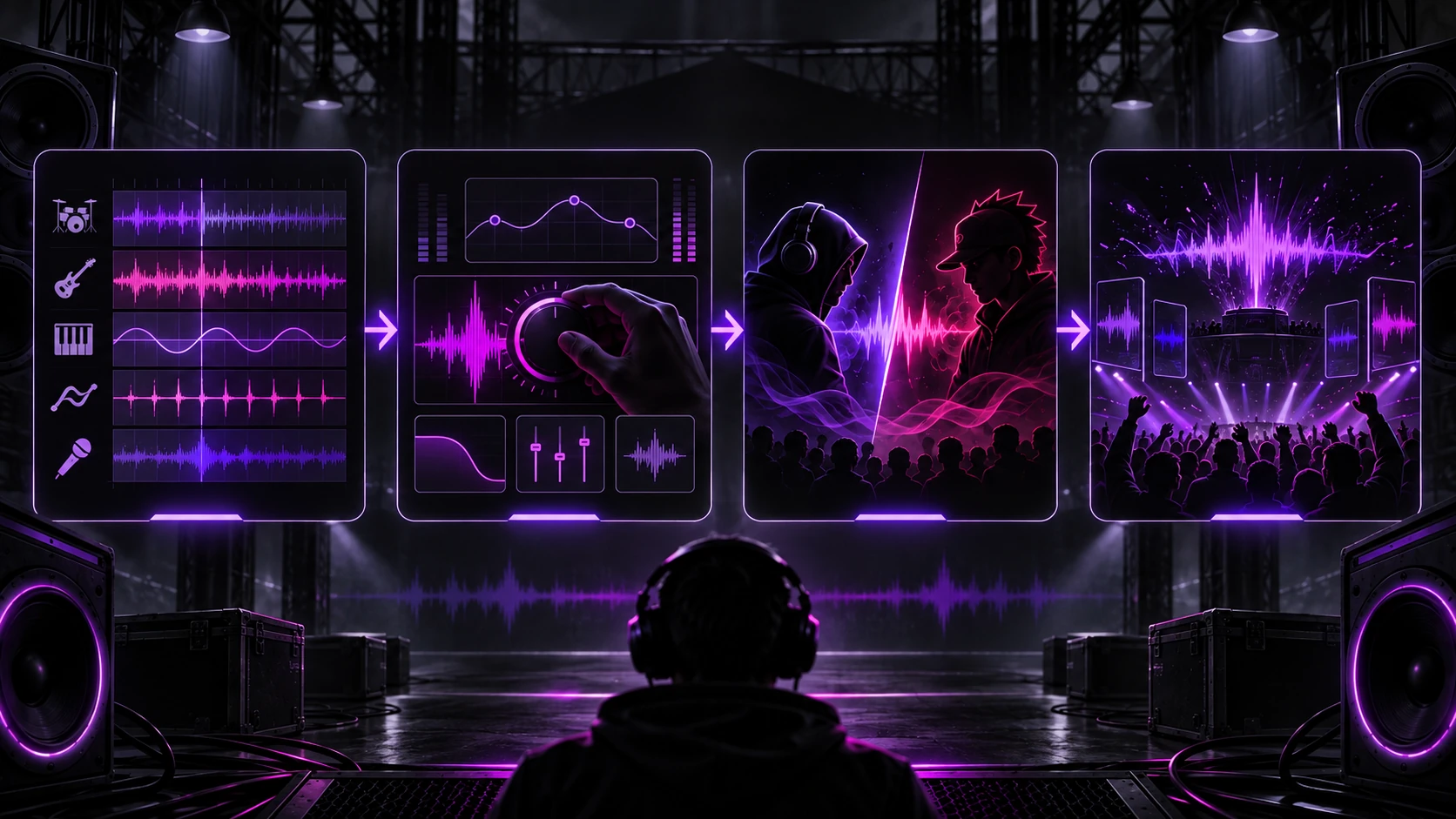
Build or configure your sound arrangement, work toward a solid and clear result, and be ready for another player to invite you to a sound battle. The arrangement is not separate from battle preparation: it is the sound that the battle interaction tests. Begin by learning the available controls and feedback instead of importing a supposed best build.
What happens in battle
The official game description says that if your sound is covered up, it is defeated and becomes less powerful. It does not publish a verified scoring formula. That means a player can safely describe the invitation, comparison and stated consequence, but cannot calculate a hidden score or promise that one arrangement always wins.
What is not confirmed
Exact component weighting, hidden scoring percentages, reward tables and battle formulas are not confirmed by the official information currently available. Treat community numbers as hypotheses until they can be reproduced across controlled tests and versions.
First-session checklist
Before a first battle, note the current arrangement, observe the feedback shown by the game, and make sure you know what changed since the last test. After an outcome, record the visible result and version context. This produces useful evidence without pretending that one result reveals the whole mechanic.
First setup
Begin with the simplest setup the current interface lets you understand. Identify which controls change the arrangement, what labels or feedback appear, and what remains unchanged between attempts. A baseline does not need to be optimal; it needs to be clear enough that a later adjustment has a meaningful comparison.
Refining after battle
After a battle, separate the visible outcome from your explanation of it. If the sound was covered up or became less powerful, record that wording and return to the last stable arrangement before changing one factor. Avoid rebuilding everything at once, because a large reset makes it impossible to know which change affected the next observation.
Beginner questions
The safest answers are also the most specific: the player creates and refines a sound arrangement, another player may invite a sound battle, and a defeated sound is described as becoming less powerful. The public information does not answer every question about formulas, rewards, or exact controls, so those topics remain version-sensitive or unverified.
A complete first session
A complete first session can be simple: read the testing warning, inspect the arrangement controls, establish a visible baseline, observe the result, and write down what changed. If a battle invitation occurs, record the arrangement and the outcome without guessing why it happened. The record becomes more valuable than a rushed attempt to copy an undocumented build.
How to improve without overclaiming
Improvement means making a change that you can explain and compare, not necessarily finding a permanent best setting. Use the language the game exposes, keep the version context, and treat a successful observation as local evidence. A result can guide the next test while still being insufficient to establish a universal rule.
When to stop and ask a new question
Stop optimizing when the next change would combine several unknowns or when the game gives no meaningful feedback. Reframe the problem: is it a control question, a saved-state question, a system question, or an outcome question? That reframing usually points to a more useful internal guide than another speculative build list.
What you are trying to do
Your practical goal is to create a Sound Arrangement you understand, refine it toward the game’s stated qualities of solid and clear, and carry that known setup into a Sound Battle. Treat each stage as part of one workflow. The setup gives you a starting point, arrangement work makes changes deliberate, testing shows what can be observed, and battle supplies an outcome to compare with the baseline. Do not begin by searching for a permanent winning recipe. Start by learning what the current interface lets you control and what feedback it actually provides. A workable arrangement that you can reproduce is more useful for learning than a complicated setup copied without evidence.
Move from setup to arrangement
Once the first setup exists, record enough detail to rebuild it. Observe its visible state before adjusting anything, then choose one change that answers a specific question. This is where setup becomes Sound Arrangement: the player is no longer placing things merely to finish, but organizing and refining a configuration for later testing. Setup alone is not enough because it gives no comparison. Without a stable starting point, a later result cannot show whether an adjustment mattered. Keep the baseline available, avoid several simultaneous changes, and return to the previous version when a test becomes difficult to interpret.
Test before making conclusions
Run the arrangement through the feedback the current game exposes and repeat the observation when practical. Write down the exact visible result, the arrangement used, and the version context. If the response changes, confirm that the setup and conditions were comparable before assigning the difference to your latest adjustment. Repeated testing does not reveal every hidden mechanic, but it prevents one event from becoming a false rule. When a result cannot be reproduced, label it observed or awaiting verification. When several variables changed together, restore the baseline and test a narrower question.
Prepare for Sound Battle
Move toward Sound Battle when you can describe the current arrangement, reproduce it, and identify the feedback you want to observe. Preserve the setup before accepting an invitation so the battle result has a clear reference. Preparation means reducing uncertainty around your own changes; it does not require knowing an undocumented score. During and after battle, separate what the game shows from why you think it happened. Record whether the sound was covered up, the stated consequence, and any visible change that follows. Do not infer exact weighting, rewards, or a universal matchup rule from a single outcome.
Refine after an outcome
Return to the saved baseline after battle and decide which single question the outcome raised. If the arrangement behaved as expected, preserve that observation and repeat it before generalizing. If it behaved differently, inspect the last controlled change first. Rebuilding the whole setup erases the comparison that could help explain the difference. Use Sound System when the overall concept is unclear, Sound Arrangement for structured refinement, Testing or Troubleshooting for inconsistent behavior, and Sound Battle for the interaction and its confirmed consequence. Data Testing and Updates provide context when older observations no longer match the current version. Exact formulas and component weights remain not currently verified.